• Skip to main content
  • Skip to footer
Revelwood Logo

Revelwood

Your SUPER-powered WP Engine Site

  • Who We Are
    • About Us
      • Our Company
      • Our Team
      • Partners
    • Careers
      • Join Our Team
  • What We Do
    • Solutions
      • Workday Adaptive Planning
      • IBM Planning Analytics
      • BlackLine
    • Services
      • Finance Transformation Services
      • Implementation Services
      • Customer Care
        • Help Desk
        • System Administration as a Service
      • Workday Adaptive Planning Integration Center of Excellence
      • Training
        • Workday Adaptive Planning Training
        • IBM Planning Analytics / TM1 Training
    • Products
      • DataMaestro
      • LightSpeed
      • IBM Planning Analytics Utilities
  • How We Help
    • Use Cases
    • Client Success Stories
  • How We Think
    • Knowledge Center
    • Events
    • News
  • Contact Us

FP&A

FP&A Done Right: Are you Ready to Start Analyzing Differently?

November 22, 2019 by Revelwood Leave a Comment

FP&A Done Right

This is a guest blog post from our partner Workday Adaptive Planning, written by Anders Lui-Lindberg. Lui-Lindberg’s blog post fits perfectly with our series’ theme of sharing insights on how the Office of Finance can change from traditional budgeting and “business as usual” to more agile, sophisticated practices.

 If there’s one thing a finance professional can do forever, it’s analyze stuff. We’re never short of data to analyze, and there are always more details to be ironed out. We love analyzing stuff so much that we almost forget the purpose of doing the analysis.

The purpose is to improve business performance through improved decision-making. That means that the analysis must produce an outcome that can be presented and discussed with business leaders. Too often though, we don’t get to that stage, and yet again finance falls short of making an impact.

It’s time to change the ideal of a good finance professional

I’ve often heard: “You can be the best finance professional in the world, but if you can’t communicate the results of your analysis, then it doesn’t matter.”

There’s only one problem with this statement. If you can’t communicate the results of your analysis, then you’re not the best finance professional in the world! In fact, in a disrupted finance value chain, you’re not much good at all.

I know this is a tough message, but we must signal to all finance professionals that doing analysis will soon be a thing of the past when algorithms and machine learning take over. Through these, we can get much deeper insights and at a much faster pace. Sure, humans might still need to put some finishing touches on it or spend a bit of time interpreting the results, but forget about spending days analyzing stuff in Excel.

Today when I ask finance professionals how much time they spend on the different activities in the value chain, “analysis” often hits 30%. That’s 30% on your own, behind a screen, doing analysis in Excel or some other tool. Granted, if in that time you can produce several golden nuggets of insight that can significantly improve decisions, then it might be worth doing. Most often we don’t though, and if you consider that an additional 35% of the time is spent on working data and reporting, then it leaves very little time to work with your stakeholders to improve their decision-making.

What kind of analysis are we really doing then?

So, what’s an ideal finance professional? We’ll uncover more of the answer in later articles, but building upon a week in the life of the business partner as pictured below, let’s look at how much time is spent on analysis.

It’s Monday morning, and the report landed on your desk as we saw in last week’s article, “Who’s running your reporting landscape?” You spend 15-30 minutes looking through the report to both ensure that the data makes sense and analyze the key developments. Through your previous dialogues with your stakeholders, you already know what’s happening in the business and therefore can much faster connect the variances to real business events.

You’re now ready for the weekly Monday meeting with your stakeholders. We’ll talk more about what happens there next week. On Tuesday though, it’s time to do some more analysis, but in a different way. Here you problem-solve with your stakeholders on how to improve business performance. You use a structured framework to consider your options and prepare a final recommendation to be presented on Wednesday. This could still take a full day or a day and a half, but as much as you’re analyzing your options, you’re also discovering insights and influencing decisions already through the problem-solving stage.

As you can see, this is a very different approach to analysis compared to what you’re used to. Instead of being buried in Excel sheets, you’re out there discussing real business problems with your stakeholders and together with them coming up with solutions. Those solutions, if designed and executed well, will bring tangible value to the bottom line of the company. Are you ready to start analyzing differently?

Anders Lui-Lindberg is a senior finance business partner at Maersk and the co-founder of the Business Partnering Institute. He is also the co-author of the book Create Value as a Finance Business Partner and a longtime finance blogger with more than 33,000 followers.

This blog post was originally published on the Workday Adaptive Planning blog.

Home » FP&A » Page 5

Filed Under: FP&A Done Right Tagged With: Adaptive Insights, Financial Performance Management, FP&A, FP&A done right

The FP&A Alignment Gap and How to Avoid It

October 31, 2019 by Ken Wolf Leave a Comment

We buy new software solutions expecting that we made the best choice in technologies and service providers, and that we’ll get years of productive use out of them. And, we were right… at the time. Then, we ask ourselves, “Why are my users complaining that the software stinks? That performance is unbearably slow, or that it simply doesn’t work for them anymore?” It’s something we at Revelwood call the Alignment Gap.

When we first rollout our new software solution, it’s in perfect alignment with our business needs. We gathered our current business requirements and probably worked with a consulting firm or service provider to translate those requirements into the ideal solution. At the point of rollout, the gap between our needs and the solution is hardly visible. However, over time several things happen:

  • First, our business needs evolve. We enter new markets, make acquisitions and reorganize ourselves to address these changes. Perhaps we start to outgrow our original requirements.
  • Second, we start to tinker with the solution to make it work better for us. These one-off tweaks start to look like holes in the dam that we’re plugging without any overall plan on how it should all fit together.
  • Finally, the technology itself improves, but we fail to take a step back and figure out how we can take advantage of its new features and capabilities.
The FP&A Alignment Gap

These dynamics create an ever-widening gap between our needs and the solution we were once so excited about. The wider that gap is, the greater levels of dissatisfaction we experience from our users and by the organization as a whole. Eventually, we get to the point where nobody is happy, and users begin to trash talk the software itself, rather than how we’re misusing it. So, how do we keep the Alignment Gap as narrow as possible?

The biggest mistake companies make is that they don’t ensure an ongoing review and assessment of their software solutions so that an Alignment Gap never occurs in the first place. Imagine never going to the doctor for a check-up, but expecting that you’ll remain in perfect health forever. Imagine not bringing your car in for service periodically to make sure that you don’t break down when you’re out on the open road. It is critical to examine your software solutions on a regular basis to ensure they continue to meet your ever-changing business needs. And, you must invest in incremental improvements to reflect those needs and keep your solution current and relevant. These incremental changes will cost a lot less than the impact of low user adoption, unreliable results and the effort required to revisit the marketplace and invest in a whole new technology platform to solve the problem. Chances are, your current technology is not the problem… it’s how you’re using it!

Fortunately, Revelwood has a service offering for FP&A solutions that eliminates the  Alignment Gap. It’s called Performance Tune-Up and involves a thorough review of your solution at an appropriate frequency to ensure that it continues to operate efficiently and meets your changing business needs.

Don’t let the Alignment Gap erode the health of your FP&A operation. Talk to us today about our Performance Tune-up service.

Home » FP&A » Page 5

Filed Under: FP&A Done Right Tagged With: Analytics, Financial Performance Management, FP&A, FP&A done right, ken wolf, Revelwood

Alternatives to Traditional Budgeting

September 20, 2019 by Brian Combs Leave a Comment

FP&A Done Right

Now that we have spent some time discussing several problems with traditional budgeting, let’s look at some alternate approaches. Here is a review of the first three problems from my prior blog:

  • Time Consuming and Costly
  • Quickly Irrelevant and Outdated
  • Financial Process Largely Disconnected from Specific Drivers

The biggest problem to me is the overall value (or lack thereof) that a traditional budgeting process provides the organization. The concept is sound. The execution is where the opportunity lies.

FP&A Done Right: Alternatives to Budgeting

One of the first steps is to determine the correct level at which to forecast. I’m referring to the number of accounts and entities (cost centers, profit centers, store fronts, functional areas, etc) you choose to budget. We often believe that more is more. In my experience, that is not true at all. Less is more. More detail means more time, not necessarily a better plan. There will always be puts and takes in your numbers as the year progresses and you compare actuals to budget. But if you build a very granular plan at the beginning, I have found that you end up with more misses. This is due to the budget review process where it is easy to look at the numbers through rose colored lenses. “The powers that be” make you bring every account or entity that is worse than prior year back to PY levels while keeping the goodness already baked in to other locations and accounts. You rarely get the offset so you end up with an unrealistic plan since we only take away one side of the equation.

Plan at the lowest level required for operational planning so you can get people, product, and capital in the right places at the right quantities. Your plan needs to be strategic in nature and should provide enough detail to allow for downstream capital planning. Don’t waste your time getting caught up in the weeds because the value add is simply to low. You must strike the right balance between detail and value to the company. As you spend time collecting numbers and assumptions for a given item, always ask yourself whether it provides actionable intelligence that will help you make meaningful decisions that drive the business forward.

As we learned in a prior blog, almost 50% of respondents stated that their business plan was outdated 1-3 months into the plan year. Wow!  Many of us spend several months on our plans only to have them become useless shortly after they are finalized. They become a variance column on our monthly reporting and then we just use it to see if we are on track for our bonus or not. If we agree that a business plan can still add value (which I do), then we need to find ways to shorten the amount of time it takes to complete.

One way that has multiple benefits is to make your budget driver-focused. Not only will this make the update process quicker, but it will help you connect your budget across all functions in your company. You need to ensure that your budget does not become a simple numbers game by aligning with operations, marketing, IT and others to build linkages throughout the organization, understand their needs for the upcoming year and create a shared vision that you are all marching towards. Choose the Key Performance Indicators (KPIs) that drive your industry and incorporate those into your planning process so you can quickly update your revenues and expenses. In my FP&A days, I focused on Rate per Day, Rate per Transaction, # of Transactions, # of Days, Transactions Per Employee, Average # of Vehicles, % of Revenue, etc. Armed with these assumptions, you can quickly update your budget when the need arises. Use these drivers to plan variable costs and then utilize a simple inflation factor to plan for your fixed costs. Here is a basic construct I have used successfully for many years:

(Rate * Driver) + Increment

The first part is clear. The increment is important because it provides the ability to plan for one-time items without having to artificially alter a rate to back in to the number. Without an increment or adjustment account, we lose the power of iteration as we can no longer simply update the driver because each rate needs to be reviewed as well to normalize it again for your starting point. Let’s say I have a particular expense that typically runs $100 (rate) per widget (driver). But I know that next month I have a one-time expense of $250 (increment). Using the above formula, I can easily increase my account by $250 to incorporate the one-time items. You can also use this to make last minute adjustments to your rate driven accounts without creating unrealistic rates.

While there are many changes you can make today that can help you avoid these pitfalls, we only had time to discuss a few here. We will look at a few more strategies in my next blog. As always, if you have some ideas to share or want to discuss further, please reach out.

Read more blog posts in Brian’s FP&A Done Right series:

FP&A Done Right: There is Life After December – The Fixed Forecast Dilemma

FP&A Done Right: Beware of Budgeting, Part I

FP&A Done Right: Beware of Budgeting, Part II

Home » FP&A » Page 5

Filed Under: FP&A Done Right Tagged With: Analytics, Beyond Budgeting, Budgeting, Budgeting Planning & Forecasting, Financial Performance Management, FP&A, FP&A done right, Planning & Forecasting, Planning & Reporting

FP&A Done Right: Beware of Budgeting – Part II

August 9, 2019 by Brian Combs Leave a Comment

FP&A Done Right

How is your budget/budget prep coming along? Have you set aside time to rethink your process? In that last installment of FP&A Done Right, we started our enumeration of the problems with traditional budgeting. Before I discuss several more, here is a reminder of the last few problems:

  • Time consuming and costly
  • Quickly irrelevant and outdated
  • Financial process largely disconnected from specific drivers

Let me highlight more now and then we will move towards some alternative approaches.

Principled upon negotiating/gamesmanship

I can still remember my first visit to Corporate to review (or as I soon learned, to defend) our annual budget. Back then, I was fresh off my MBA and I had landed a job at one of our Region offices. We had just spent months building a plan from the lowest level, capturing input and feedback from every location manager and painstakingly describing every variance to the penny. We were ready. This was a done deal. Boy was I naïve. We were escorted into a nice room with a large table. Around the table I could see the president of our division and the heads of every major functional area ready to discuss our plan. Game on! My controller and I didn’t even get a chance to pull out most of the backup schedules we had created. He spent his time trying to negotiate fewer expense reductions and less revenue while I was busy taking notes on all the “savings” and “initiatives” the team had just found for us during the review. Great news. Thanks for the assist. I learned my lesson that day. After that, I knew that I had to pad my expenses and sandbag my revenue. They knew we did it too which is why they had us take a 5-10% cut in expenses as soon as we walked in the door. That is a difficult game to stop playing and, in the end, no one wins. Yet, many of us continue to play.

Triggers Unnecessary Spending

Since our budget numbers are frequently tied to prior year spend rather than being based on needs (a zero-based budgeting approach), we feel the need to spend money just so we have the same amount available to us next year. This is crazy, but I still see it today. We should be creating an environment where our front-line managers are rewarded for being fiscally conservative, not penalized. If you find a way to save money this year, we should be analyzing what you did so we can replicate it with your peers rather than giving you a hard time next year since you now have a large YoY increase.

Creates an inflexible performance contract

This is a big one as it impacts your managers directly in their bank accounts. This is especially true when incentives are tied to performance against the annual business plan. Once my budget was completed, I knew I would spend the rest of the year running actuals vs budget reports so we could determine what our bonus would be. If you remember from the first part of this blog, almost two-thirds of budgets are outdated between 4-6 months into the plan. If that’s the case, why are we using that number to determine the bonus for our managers? I want to reward my managers for changing course if they see something that is in the way of them achieving their goals. Compensate them based on what is occurring now, not what you thought was going to happen 12 months ago. When we focus on an inflexible budget number, we begin to manage to that number.  Don’t fall in to that trap.

Drives Wrong Behavior

It doesn’t take long before you know roughly where the year will pan out vs the budget. You know fairly quickly whether it is attainable or a long shot.  Since compensation is tied to the budget, it tends to drive the wrong behavior. You should expect your managers to do what is in their best interest. It is your job to ensure that by doing so, the company gains as well. If I am in the back half of the year and I already know I can’t achieve my annual budget numbers, where is the incentive for me to continue to find cost savings and improve my processes. I might as well give up on trying to get better this year because I won’t reach my bonus threshold anyway.  Right? Maybe I’ll push off a cost savings initiative until next year.  Or I’ll try that new revenue generating idea at the start of next year. The same is true if you have already maxed your bonus for the year. Why continue to do better? Save some of that goodness for next year. You need to make sure that the company goals are aligned with the individual goals. A budget can create a false sense of security and it may be holding the organization back from achieving its true potential.

It’s often easier to ‘see’ a problem when someone else describes it. My hope is that while reading this, you took some time to compare and contrast these issues with your methodology and approach to the budget. Does anything look familiar to you? If so, perhaps it is time to make a change.  Please reach out and share your stories with me. In my next blog, we’ll discuss some alternatives to these problems that you can begin using immediately.  Happy budgeting!

Read more posts in Brian’s FP&A Done Right Series:

FP&A Done Right: Beware of Budgeting, Part I

FP&A Done Right: The Importance of Including FP&A Often and Early in Your Strategic Planning Process

FP&A Done Right: 5 Signs it’s Time to Rethink Your Process

Home » FP&A » Page 5

Filed Under: FP&A Done Right Tagged With: Analytics, Beyond Budgeting, Budgeting, Budgeting Planning & Forecasting, Financial Performance Management, FP&A, FP&A done right, Planning & Forecasting, Planning & Reporting

FP&A Done Right: Beware of Budgeting

July 26, 2019 by Brian Combs Leave a Comment

FP&A Done Right

“Not to beat around the bush, but the budgeting process at most companies has to be the most ineffective practice in management. It sucks the energy, time, fun, and big dreams out of an organization. It hides opportunity and stunts growth.  It brings out the most unproductive behaviors in an organization, from sandbagging to settling for mediocrity. In fact, when companies win, in most cases it is despite their budgets, not because of them.” – Jack Welch, former Chairman and CEO of General Electric

That is a pretty strong statement, but I bet many of you are smiling. You know, that uncomfortable smile you make when someone says something that hits a little too close to home. As an FP&A guy who has spent plenty of time building those budgets he’s talking about, that quote certainly speaks to me. He makes some great points though. Despite that, budgeting is still deeply embedded in our corporate culture. As you embark on the 2020 planning season, this is a good opportunity to rethink your process. Let’s examine a few of the problems with traditional budgeting.

Time Consuming and Costly

I’m preaching to the choir on this one. You know how much time and effort is spent on the budgeting process. There are typically multiple passes that include all levels of the organization, presentations to senior management where we “defend” our budget, and the thought that more is somehow better. More schedules, more pages in the deck, more passes, more reviews.  It’s maddening. We capture more detail than anyone could possibly know in the future and many of us still compile it using Excel (don’t get me started on that one…). It is difficult to get timely information that you can use to help build a reasonable budget.

Quickly Irrelevant and Outdated

Do you make it through half of the plan year with a relevant business plan still? If so, you are in the minority. I used to feel as if I was just going through the motions knowing that as soon as it was finalized, it was useless. It simply became a method to determine my bonus, not a method for driving the business forward.

Business Finance conducted a survey several years ago and they asked respondents to tell them when their current year’s budget became outdated. Based on my experience, these numbers still hold true.  Take a look at the responses:

28%:  Before the plan year begins

48%:  1-3 months in

67%:  4-6 months in

70-75%:  Before 2nd half of year

What are doing? Why do we continue this process?

Financial Process Largely Disconnected from Specific Drivers

How often are you building your plan with driver-based accounts? Are you starting with your line/operation managers and asking them what they can actually achieve next year? If you are, great! What I often see, however, is a disconnect between the P&L, oftentimes created in a vacuum, and operations. We talk about our plan in terms of YoY growth rather than focusing on the macro and micro indicators that surround us today. We build plans with months and quarters in mind while the business may be run by weeks or days or cycles. If you aren’t focusing on the specific drivers of your business, you risk creating an unattainable plan and you will spend the entire year making up variance analysis comments.

There are several other challenges with traditional budgeting that I’ll discuss in my next blog. Then, we will talk about alternatives to this and what our next steps can be. For now, just know that we can help show you another way. Decide right now that this will be the last traditional budget you do.  2020 is it!  Give us a call. We’re here to help.

Read more posts in Brian’s FP&A Done Right Series:

FP&A Done Right: The Importance of Including FP&A Often and Early in Your Strategic Planning Process

FP&A Done Right: 5 Signs it’s Time to Rethink Your Process

FP&A Done Right: Creating a Shared Vision Between Finance and IT

Home » FP&A » Page 5

Filed Under: FP&A Done Right Tagged With: Analytics, Budgeting, Budgeting Planning & Forecasting, Financial Performance Management, FP&A, FP&A done right

The Importance of Including FP&A Early and Often in Your Strategic Planning Process

July 12, 2019 by Brian Combs Leave a Comment

FP&A Done Right

The Strategic Planning process at many companies is in sore need of an overhaul. As many of you know, the “Strat Plan” can take on a life of its own. It was not too long ago that I was the guy who had the pleasure of creating and consolidating the Strategic Plan along with all the initiatives created by our VPs and functional areas. The greenfield initiatives. The cost savings initiatives. The sales and marketing initiatives. The IT initiatives. The “I have this great idea that will generate millions in revenue with zero cost” initiatives. Need I continue?

They all sounded great and many of them had reasonable assumptions, but it was simply not possible to complete all those initiatives in the year. On top of that, there were diminishing returns with each cost savings measure and many of the strategies required access to the same resources and capital. The owner of each initiative treated the benefits as if their initiative was the only one that would take place. It became my job to push back and infuse a bit of realism in the numbers since I had the big picture view and was crafting the overall story. 

I frequently said to myself, “Wow, I wish I had known about all of these great initiatives at the beginning of the planning cycle.” As I added all the initiatives to my model, along with all the goodness they were supposed to create, I was left with a huge same store decrease as my plug. Or I played the inflation factor game and increased my cost assumptions. As Anders Liu-Lindberg said in “Why FP&A Must Transform the Strategy Process,” “…by the time FP&A gets involved it’s often too late to shape the strategy, so FP&A resorts to cooking up some numbers based on the strategy.” My P&L was substantively complete before I received the strategic components that summed together to support it! Now that I had all these “good guys”, I needed to create “bad guys” to offset them so I didn’t end up with an unrealistically high profit in my plan. 

It is critical to include FP&A in your strategic planning process as early as possible. Become a true Finance business partner and engage with the respective owners before they begin to create the pro forma P&L for their initiative. Once those are all created, compile a summary of them and send it out to the entire team. In my experience, that sparked discussion amongst the senior team since they could now see the same overlaps that I did. Communication is almost always the answer. This will allow you to become a facilitator of the process rather than an actor who appears in the closing scenes of the movie to tie up the loose ends. 

I have written in the past about the importance of Finance acting as the conductor/storyteller. By involving FP&A earlier in the process, we can ensure that the story is centered around a unified vision rather than a piecemeal strategy that is more akin to a book of short stories. The latter provides everyone something that may be important to them, but the collective is weaker as a direct result. Utilize your FP&A team to make the tough decisions early in your strategic planning process so the company can rally around those initiatives and create a roadmap to get there.

Read more posts in Brian’s FP&A Done Right Series:

FP&A Done Right: 5 Signs it’s Time to Rethink Your Process

FP&A Done Right: Creating a Shared Vision Between Finance and IT

Why, Why, Why, Why? – The Hallmark of a Great FP&A Practitioner

Home » FP&A » Page 5

Filed Under: FP&A Done Right Tagged With: Analytics, Financial Performance Management, FP&A

FP&A Done Right: 5 Signs It’s Time to Rethink Your Process

June 28, 2019 by Brian Combs Leave a Comment

FP&A Done Right

If you have been following this blog series, you know that I am a ‘people and process’ guy. I’ve discussed how we become so good at circumventing the process that those workarounds become the process. Keep in mind, however, that a workaround, by definition, is meant to be temporary. When you are stuck in the weeds of your daily tasks, it’s almost impossible to see that your process is askew. If that is the case, how can we recognize that it’s time to step back and rethink our planning and reporting process?

Based on my years of experience in FP&A practice and consulting, I’ve pulled together 5 signs that it’s time to rethink your process. Some of these can be corrected with minor tweaks to our systems while others may require a major overhaul.

Offline manipulation of data

This is a telltale sign that something is off. There are any number of reasons that we do this. I used to do it because my boss wanted a different number than my system-generated reports were producing. Note that I said different, not necessarily right. Oftentimes, we have multiple metrics and KPIs with the same or similar names, but different calculations. Maybe we want to back out a few GL accounts from a certain Revenue metric or we have a series of ‘one-time’ exclusions. (On a side note, that’s an interesting phrase. In my experience, those one-time exclusions are used many times…) It is easier to simply massage the data or create our own math in Excel to complete the task at hand. After all, I can justify anything with a footnote! We should, however, be challenging the intent behind these requests. Perhaps your reporting capabilities are limited and you use Excel schedules to standardize outputs. Sometimes we export data so we can marry it up with data from other systems and reports. At the end of day, when you manipulate data offline, you lose the power of your planning and reporting tool and you turn it into a basic report repository.

I’m sure you can think of many other reasons why you need to manipulate data offline.  I will argue that each of them can be solved with process or system changes. 

No standardization across your business units and functions

This is a big one for me. The lack of standardization and automation of technology and process makes it difficult to streamline your actions and to understand the root cause of an issue. I frequently heard, “Brian, we don’t do it that way. It’s different in my department . You don’t understand.” If you choose your metrics and processes correctly, that is not true. Management and FP&A must have the ability to drill from the macro to the micro. If I see a variance or issue on a report for my global rollup, I need to be able to drill all the way down to the store front or profit/cost center to see what the driver is. If every location is not using the same metrics, calculations, or account granularity, my analysis can be misleading. I love ranking and quartiling reports. By focusing on metrics at the individual locations, I can learn what works and what doesn’t work and then educate the front line on changes they can make that are working for their peers. This only makes sense, however, if you have an apples-to-apples comparison.

Keep in mind that while working towards standard processes, you must ensure you get universal adoption. Without that, you will find that people will revert to their previous methods and will ignore your new process (see the first sign above). 

Last-minute changes to your forecast or budget cause a frenzy of activity

I can still remember the feeling when my phone rang at 5:29pm the night before a big deep-dive review or Board Meeting. You know what I’m talking about. THE call. You finally completed running the last round of budget changes through your process, validated the numbers, copy/pasted all the charts and graphs and you are printing the books. “I’m going to get home for dinner tonight!”, so you thought. Your next call is home telling your family you will be late again because you have another long night ahead of you. It doesn’t have to be this way. 

The reason I dreaded that call was because we didn’t have a clearly defined, connected process that allowed me to make changes quickly and flow them all the way through my system to produce the requisite output. Instead, I knew the pain that was about to ensue. I was going to cobble together my financials and hope that I didn’t miss anything (which I often did). Your goal should be to have a rock-solid process such that you can make changes quickly and then seamlessly push them through. Easier said than done, yes. But, I know you can do it. We’re here to help.

Lack of integrated functionality within your legacy applications

Many times, we have disparate systems and processes across business units, geographies and corporate functions. The concept of a single source of the truth seems like a myth or fable. We may feel as if we are on a quest for fully integrated 3-statement reporting (P&L, BS, CF). The lack of integration is also a root cause for other items that I have discussed. Since our systems do not speak to each other, we export everything to Excel, The Great Aggregator. This leads to using offline schedules to generate reports which leads to a lack of data governance and control which leads to confusion at best and misdirection at worst. There are steps you can take today to improve this while you are working towards a longer-term solution.  Automation of certain items is easier than you think.

You do not have real-time, collaborative tools

Instant feedback is extremely important when timelines are tight and decision support is needed quickly. The pace of business today is so fast that collaboration is becoming a requirement. If you are still driving your forecast and budgeting process with Excel, you have an opportunity for improvement. Stop the proliferation of static Excel files that constantly get changed or broken. There are many tools that will allow you to become more collaborative. The answer to this doesn’t have to be the implementation of one of the planning, reporting, and analytics tools on the market today (although I highly suggest this route). I have seen collaboration accomplished with Google’s suite of products, Smartsheets, Box or other shared access products. The key is that you need a platform that allows you to be nimble and quickly react to changes on the ground. Enable each group to input their items and have them flow throughout the system so everyone sees the impact immediately and can approve or deny and create actions plan. Make sure to create a roadmap that charts your path from where you are today to that future state where you have a planning, reporting, and analytics solution that can provide instant gratification, feedback, and ease of use. 

Did any of these signs strike a chord with you? Most of us probably see these in everyone else’s process around us.  But guess what, others may these signs in your planning and reporting process. As we approach the start of next year’s budget season, set aside some time to question the steps you are about to take. Perhaps it is time to rethink your process.

Read more posts in Brian’s FP&A Done Right Series:

FP&A Done Right: Creating a Shared Vision Between Finance and IT

Why, Why, Why, Why? – The Hallmark of a Great FP&A Practitioner

Guest blog post from Adaptive Insights: How to Improve Cross-Team Collaboration

Home » FP&A » Page 5

Filed Under: FP&A Done Right Tagged With: Analytics, Financial Performance Management, FP&A

FP&A Done Right: There Is Life After December – The Fixed Forecast Dilemma

June 14, 2019 by Brian Combs Leave a Comment

FP&A Done Right

While this may be an old concept, the Fixed Forecast Dilemma still holds true today. Not too long ago, this was a fairly arduous task, even if you wanted to undertake it. This is now primarily a mindset change because today’s planning, reporting and analytics systems make this task much easier than in the past. 

Artificial Wall

We create this disconnect between current year and next year – in our minds as well as in our systems. We spend the bulk of our time focused on our current calendar or fiscal year and create this artificial wall that is difficult to see beyond. When analyzing actions, we think in terms of how it impacts our Total Year period because that is the report deck I need to pull together once I finish my forecast. We don’t always think about how my actions today impact the out months. “That’s a budget problem, I’ll worry about that when I put that hat on,” I used to say.

Our systems are created to support this philosophy as well. We put our forecast and our plan in separate scenarios which makes the divide even deeper. This Year. Next Year. 

FP&A Done RIght: The Fixed Forecast Dilemma

As you know by now, I spent many years in FP&A in the car rental business. We initially used the standard January to December forecast period. We started with our annual budget. January was always a good month; there’s no way we were going to show a number different from the budget we just spent so much time on, so it was an easy ‘copy/paste’ job to our Current Estimate version. As the months and quarters progressed, we layered in the actuals and updated the remainder of the year. Nothing more, nothing less. This was a short-sighted process that led to increasingly limited visibility. It was as if we weren’t going to rent a single car on January 1st! Don’t get me wrong, I did enjoy the forecast more as the year progressed since I had one less period to create and analyze each month. Come the Aug/Sept timeframe, I actually got home at night before my wife and boys were asleep! The primary issue is that the calendar year construct focuses attention on the accounting year rather than the ongoing operational cycles which can be calendar agnostic. A continuous planning process pulls the two together.

Continuous Planning

Continuous planning cycles allow us to become more strategic in our thinking and give us a visual cue that our business is continuous and there is, indeed, life after December.  It links our operational and financial strategies and goals.  Start using your forecast as a legitimate roadmap which shows your current landscape rather than just a report that you plug back to the annual plan to avoid questions (I may have played that game once or twice…)

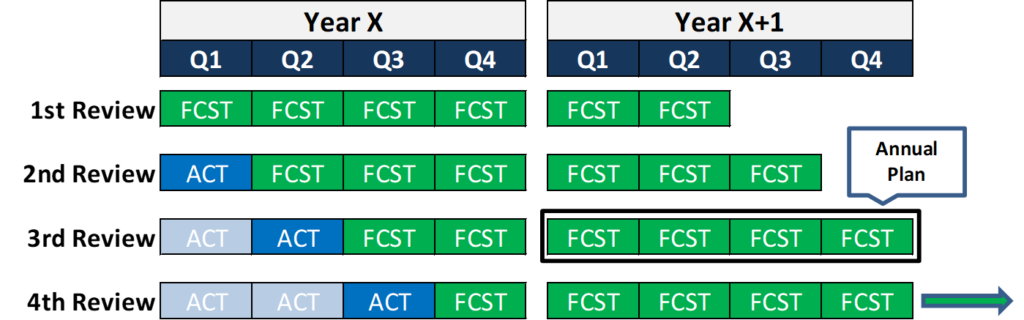
The basic idea is that we are always looking forward the same number of months/quarters. As this visual shows, we layer in the actuals but add another period at the end of our forecast timing. This is often referred to as a ‘drop…add’ planning cycle.

The Fixed Forecast Dilemma

This chart shows an 18-month forecast. Your time horizon and granularity (the level at which you forecast your accounts and locations) may be specific to your industry and should be based on the furthest point out that you have solid, actionable operational/finance visibility and needs. Several companies I have worked with use a simple rolling 12 forecast. I used an 18-month rolling forecast since that aligned with my lead times for our vehicle purchases. There are heavy capital-intensive industries which may have 30-year CapEx forecasts. If you are unsure, start with 12 or 18 months. One key benefit to an 18-month continuous planning cycle is that the first pass of your plan for the following year is completed at the beginning of Q3 this year.

Next Steps

You might be thinking, “Brian, there is no way I’m going to do 18 months of forecasting. It would take too long.” You may be right based on your current process. You should be thinking about driver-based forecasting at the same time. Focus on the key drivers of your business. Update the rates and drivers and let the system do the work. Also, start to question the granularity of your forecast. Do you really need to forecast every GL account or every store front, department, or business unit? We fool ourselves into thinking that more detail somehow equates to greater accuracy. I would argue it’s the exact opposite. Implement the continuous planning cycle along with these business process changes and you will not spend any more time on your forecast than you do today. But you will have gained more insight into the needs and expectations of your business.

Whatever you do, remember that January 1st follows December 31st every year. Don’t wait until the last minute to see what’s on the other side of the wall. 

Read more posts in Brian’s FP&A Done Right Series:

FP&A Done Right: Creating a Shared Vision Between Finance and IT

Why, Why, Why, Why? – The Hallmark of a Great FP&A Practitioner

Guest blog post from Adaptive Insights: How to Improve Cross-Team Collaboration

Home » FP&A » Page 5

Filed Under: FP&A Done Right Tagged With: Financial Performance Management, FP&A

FP&A Done Right: Creating a Shared Vision Between Finance and IT

May 31, 2019 by Brian Combs Leave a Comment

FP&A Done Right

I have seen the extremes of the Finance/IT relationship during my career as an FP&A professional. When I first started navigating the Finance space, any and all systems were ‘owned’ by IT. That’s simply how it was. There was this love/hate relationship between the two and we each thought of the other as a necessary evil. We learned to live together but there was this constant tug-of-war over the constraints of the project management triangle; time, cost, and scope. As Financial systems became easier to administer and Finance professionals became more tech savvy, the pendulum shifted and we started to move ownership of certain financial systems to the Finance team itself. I hired technical resources in my team to manage and build my systems since I could control things better that way. Finance began to own the planning, reporting, and analytics systems, but IT still owned(s) the source systems (GL, P2P, AR, FA). I am ok with this.

Planning, reporting, and analytics systems are forward looking and, as such, do not have the same regulations as the other systems. In FP&A, we need to be free to make quick changes and create “what-if” analyses to our hearts content without constantly going through the proverbial “red tape”.  (To be clear, as I’ve pointed out in past blogs, data governance is still very important and this is not the Wild West.) The collective “we” do not have the same luxury with our systems of record, however. Those need to maintain the rigor and tight controls that exist today and, oftentimes, our IT organizations are better suited for that. While I am comfortable with the division of responsibilities today, I feel as if we have separated the two functions too much. In the extreme cases, I have seen this create a disjointed approach to IT initiatives. As Sebastian Grady points out in CFO’s “How to Build a Strategic Relationship with the CIO”, it is very important to create and foster a shared vision between Finance and IT, so you can work with each other rather than against each other. “Finance chiefs and IT leaders should be jointly responsible for aligning technology opportunities with business strategy,” commented Grady. He also speaks about forging a relationship with IT and being “the bridge to a contextually rich CEO/CFO/CIO relationship.”

This should extend beyond the CFO and CIO. Think of this as the CFO’s team and the CIO’s team. FP&A lives at the intersection of the C-suite offices and we are uniquely qualified to forge those relationships. Make sure you take the requisite time to get to know your peers in the other functional areas.  Partner with someone on that team and shadow them during their respective busy time so you get a clear picture of their responsibilities. Once you have that understanding, which only comes from intellectual curiosity, you can work together to align technological initiatives with business strategy. In your quest to drive profitable growth, make sure to stay abreast of new technologies that can help make this a reality. Work directly with your CIO to make sure that the latest IT proposal provides a solid ROI while achieving overarching strategic business goals at the same time. 

Later in the article, Grady discusses how to “flip the IT roadmap on its ear.” He describes how Finance and IT can work together to create an IT roadmap that supports your business strategies and goals. There are some interesting examples in there that are thought-provoking and worth the read. None of those examples will work until you bridge the gap between the functional areas and recognize that you are stronger together. That shared vision must be rooted in mutual respect and “…a joint understanding of financial and technological strategies…”  Once again, clear, concise communication wins the day. 

Read more blog posts in the FP&A Done Right Series:

Why, Why, Why, Why? – The Hallmark of a Great FP&A Practitioner

Guest blog post from Adaptive Insights: How to Improve Cross-Team Collaboration

FP&A Done Right: “That’s the Way We’ve Always Done It!” — Challenge the Status Quo

Home » FP&A » Page 5

Filed Under: FP&A Done Right Tagged With: Analytics, Financial Performance Management, FP&A

  • « Go to Previous Page
  • Page 1
  • Interim pages omitted …
  • Page 3
  • Page 4
  • Page 5
  • Page 6
  • Page 7
  • Go to Next Page »

Footer

Revelwood Overview

Revelwood helps finance organizations close, consolidate, plan, monitor and analyze business performance. As experts in solutions for the Office of Finance, we partner with best-in-breed software companies by applying best practices guidance and our pre-configured applications to help businesses achieve their full potential.

EXPERTISE

  • Workday Adaptive Planning
  • IBM Planning Analytics
  • BlackLine

ABOUT

  • Who We Are
  • What We Do
  • How We Help
  • How We Think
  • Privacy

CONNECT

World Headquarters

Florham Park, NJ | 201 984 3030

European Headquarters

London & Edinburgh | +44 (0)131 240 3866

Email
info@revelwood.com

Copyright © 2026 · Revelwood Inc. All rights reserved. Revelwood® and the Revelwood logo are registered marks of Revelwood Inc.