• Skip to main content
  • Skip to footer
Revelwood Logo

Revelwood

Your SUPER-powered WP Engine Site

  • Who We Are
    • About Us
      • Our Company
      • Our Team
      • Partners
    • Careers
      • Join Our Team
  • What We Do
    • Solutions
      • Workday Adaptive Planning
      • IBM Planning Analytics
      • BlackLine
    • Services
      • Finance Transformation Services
      • Implementation Services
      • Customer Care
        • Help Desk
        • System Administration as a Service
      • Workday Adaptive Planning Integration Center of Excellence
      • Training
        • Workday Adaptive Planning Training
        • IBM Planning Analytics / TM1 Training
    • Products
      • DataMaestro
      • LightSpeed
      • IBM Planning Analytics Utilities
  • How We Help
    • Use Cases
    • Client Success Stories
  • How We Think
    • Knowledge Center
    • Events
    • News
  • Contact Us

FP&A

FP&A Done Right: Planning for What’s Next in Uncertain Times

September 18, 2020 by Revelwood Leave a Comment

FP&A Done Right

This is a guest blog post from our partner Workday Adaptive Planning, written by Michael Magaro. The blog post was originally published on FEI Daily.

The COVID-19 pandemic changed our world, almost overnight, and businesses are having to adjust. The unprecedented nature of the pandemic means no one knows how deep the economic downturn will be, or how long it will last, which makes financial planning for businesses especially difficult.

Fitch Ratings’ “Global Economic Outlook” states that global economic activity will decline by 1.9% this year with the U.S., Eurozone and UK GDP down by 3.3%, 4.2% and 3.9%, respectively. Some industries will be more impacted than others, and next to no one has historical experience with pandemic conditions.

Companies are clearly having a hard time planning. A survey from Gartner of 99 CFOs and finance leaders taken April 14-19 revealed that 42% of CFOs have not incorporated a second wave outbreak of COVID-19 in the financial scenarios they are building for the remainder of 2020, a finding dubbed “surprising,” by Alexander Bant, practice vice president, research, for the Gartner Finance.  Many public companies have also withdrawn guidance due to lack of visibility.

So how do companies plan when visibility is so cloudy, and unknowns are so numerous?

For the finance team at Workday, we are embracing scenario planning—basically harnessing the power of “what if”—to respond to COVID-19, and so are many of our customers. Our cloud planning platform is processing up to 30 times more forecasts and build-out scenarios for customers than in a typical, pre-pandemic week. And given the volatility and unpredictability we’ve seen, it’s not likely to ease up soon.

But the reality is that agility starts with planning. Not long before the pandemic hit, we, like many companies, had our plan in hand and were evaluating many different potential outcomes, including whether the long-running economic expansion would begin to show signs of slowing. As the realities of the pandemic came into view, we stepped up scenario planning in order to adapt to changing market conditions–and achieve the level of agility our business demands. And, while we continue to adjust and adapt like all companies, we identified five critical steps for successful scenario planning.

Step One: Assess potential impact to the top line

How will what’s happening impact revenue and the various revenue streams that feed the top line number? For many companies, this will include impacts to new business activity, customer retention, and assumptions that went into the impact of new product launches — if any exist.

Each business faces a different situation. During the pandemic, many hospitality businesses are struggling. Meanwhile, many online retailers are going strong. Each industry’s history can be instructive. During the 2002 Dotcom crash and the 2008 financial crisis, for instance, software companies with a higher percentage of SMB customers took a bigger hit to monthly renewal rates.

Because no one has historical data for a pandemic, it’s important to start off fairly basic with scenario planning. Model some elements from the top line, such as new sales, business renewal activity, and up-sell to existing customers by quarter throughout the year. Consider a range of scenarios possible for your business, perhaps 50%, 65% and 80% of a pre-pandemic plan. This gives a good view into what could happen to the income statement and balance sheet and help businesses understand variances on metrics that matter most to them. For organizations similar to Workday, that’s subscription revenue growth, non-GAAP operating margin, and, ultimately, cash flow.

Step Two: Identify levers on the investment side of the business

What levers do you have to pull? For most companies, people are the biggest cost. Do you hire as planned before the pandemic? What are the differences between hiring as planned, freezing hiring for the rest of the year, and the range of options in between? No business wants to cut job cuts at any time, so it’s important to understand other cost levers at your disposal, and the various outcomes possible when you pull them. To understand your big levers, you have to really understand your business.

Step Three: Align leadership

The finance team alone should not decide steps one and two. Involve all leaders so you get the right picture and analysis, and make sure you’ve identified the right levers. Involving leaders keeps everyone aligned and thinking about the right things. For many companies this may take the form of dashboards shared across the leadership team or creating regular review meetings.

Step Four: Identify a good outcome

Ask what a good outcome looks like for your organization. This will differ for each organization. Is it to retain existing customers? Is it to retain your workforce, or to maintain a customer satisfaction standard? Is it to expand and win market share from distracted competitors? By identifying what matters most to your organization, you’ll better prioritize through steps one, two, and three. And in today’s climate, that desired outcome may change, further elevating the importance of a continuous approach to planning.

Step Five: Dive deeper

Once you have your various scenarios, and have received feedback on them, dive deeper. For some companies, this will mean digging into supply chain issues, for others it may be assessing risk by segment, etc. Third-party research can help you decide how to respond. For instance, if you know a number of your suppliers or customers are feeling a lot of pain, how can you be proactive in supporting them? Align various teams on this topic, too. For instance, sales and customer service hear directly from customers. Their knowledge should inform your analysis and drive your ability to help your customers, partners, and your own top line.

Scenario planning to continuous planning

Even prior to the pandemic, Workday’s finance organization was working toward a continuous planning framework. Our aim is to shift from annual planning and budgeting to continuous planning via more frequent reviews and assessment of how changing conditions impact our product roadmaps, and vice-a-versa. Along the way, we look at such things as margins and cash flow. Whenever conditions change, we anticipate being able to take action and adjust our model. For instance, if product development runs behind schedule, do we adjust by upping investment to get it back up to speed or do we adjust our top line estimates? If we’re operating correctly under the continuous planning framework, planning is not a point in time—it is continuous.

Embracing flexibility

The pandemic is challenging us as humans, as companies, and as business partners in all kinds of new ways. When any crisis hits, finance teams need to be able to seamlessly navigate the kinks that come with uncertainty. Scenario planning—and eventually continuous planning—enables us to embrace flexibility and to use it our advantage.

This blog post was also published by Workday Adaptive Planning and appeared here.

Home » FP&A » Page 4

Filed Under: FP&A Done Right Tagged With: Budgeting Planning & Forecasting, continuous planning, COVID-19, Financial Performance Management, FP&A, FP&A done right, Planning & Forecasting, Planning & Reporting

The Impact of COVID-19 on Lease Planning and Management

August 10, 2020 by Lisa Minneci Leave a Comment

FP&A Done Right

The COVID-19 pandemic has impacted almost every industry – and will continue to do so into the foreseeable future. Corporate real estate and the real estate investment trust (REIT) industry are examples that have gone from fairly predictable scenarios to areas that have been completely upended.

As a result of the coronavirus, many global employers are debating the need to have their employees work in large offices at all. Barclays’ CEO told CNBC that “crowded corporate offices with thousands of employees may be a thing of the past.” Along with Barclays, Mondelēz, Nationwide, and Twitter are talking about a “permanent shift to work from home and reduced office space.” The reasons range from safety to insurance to cost savings. In fact, a Reuters analysis of “quarterly earnings calls over the past week (week of July 15, 2020) revealed that more than 25 large companies plan to reduce their office space in the year ahead, a move designed to reduce the second-largest expense after payrolls.”

A typical REIT company normally holds millions or billions of dollars in assets in office space. They should have a good understanding of which leases are coming up for renewal or expiration, and which buildings will have extra capacity. They look long-term to fill space and maximize revenue opportunities.

Suddenly, as a result of COVID-19, REITs are faced with tenants who are viewing their office space commitments very differently. Many businesses, like retailers and restaurants, have been closed for months. Some are still closed. Some are re-opening slowly. Some face the prospect of future shut-downs. Businesses have asked landlords for rent concessions, and some U.S. cities and states have issued guidelines supporting rent concessions. Regardless of the reason, tenants are now asking for lease modification options. These include partial terminations and reductions in space.

It is possible to “model” real estate assets and leases on spreadsheets, but it is simply not possible to manage this level of complexity, and do so in near real time, with a spreadsheet. In order to truly understand the total impact of rent concessions and lease modifications across multiple buildings, in different states, throughout the nation, a real estate holding company or a REIT requires sophisticated planning software. These firms must be able to do “what-if” scenario modeling. They need to have a clear picture of capacity, in order to move tenants or divest of assets, if needed. They require a solution that is agile, flexible and dynamic.

It’s hard to predict what will happen over the next few months or even the next year, but it’s clear that the real estate industry will see lots of change, fluctuation in leases, and unpredictability.

Read more blog posts about the impact of COVID-19:

FP&A Done Right: The Office of Finance in the COVID-19 Economy

FP&A Done Right: FP&A Tips for Scenario Modeling During COVID-19

FP&A Done Right: Reforecasting in a COVID-19 World – Best Practices You Can Implement Now

Home » FP&A » Page 4

Filed Under: News & Events Tagged With: Budgeting, Budgeting Planning & Forecasting, Financial Performance Management, FP&A, Planning & Forecasting, Planning & Reporting, real estate investment trust, REIT

FP&A Done Right: What Must FP&A Do Differently to Make Planning a Success

June 5, 2020 by Revelwood Leave a Comment

FP&A Done Right

This is a guest blog post from our partner Adaptive Insights, written by Anders Liu-Lindberg. Lui-Lindberg explains why FP&A can no longer take a narrow view of its own role.

FP&A is obviously concerned with financials; however FP&A can no longer take a narrow view of its own role. FP&A must go way beyond the financials to where the business happens to succeed in making planning a success!

We discussed in my previous post the notion of active planning and made it concrete using a specific example. Now we’ll take it one step further and discuss how you can only realize active planning if you integrate your planning process with business operations.

In the end we’ll tie it all together by explaining how you can now build a driver-based planning process that ties your strategic intent together with your daily execution. I know that’s a stretch to most FP&A professionals, but with active planning it doesn’t make sense any other way than to make your planning driver-based.

External factor to business drivers to financial drivers

I think we can all agree that business doesn’t start with financials. In fact, it ends with financials, when every transaction eventually gets recorded through debit/credit. So how could we ever start our planning process with the financials or think that by extrapolating current financials with a growth factor or similar that we would get a decent picture of what will happen in the future? No, we must flip our thoughts on planning around. Here’s how:

  • We must look at the external factors that impact our business and are documented as critical assumptions as part of our strategy
  • Next, we must look at the key business drivers that determine if we’re successful or not
  • Only then do we start to look at the financials, because they’re the most lagging indicator we have

In short, external factors are leading indicators to business drivers, which in turn are leading indicators to financial drivers. Now it’s important that you only select the most critical ones, say six to eight in each category, because otherwise you’ll have a hard time describing how each factor/driver impacts the other. You’ll also have a hard time producing any meaningful monitoring system or planning process.

It’s clear that the more variables you can add to the equation the more precise you’ll likely be; however, to exercise active planning, an 80/20 approach is much better than thinking you need 99% accuracy in everything you do.

Almost real-time driver-based planning

Now let’s connect the dots. You’ve defined six to eight drivers at each level of external, business, and financial. You should now connect these drivers so you have an idea about how a change in one will change the other. You might need to use some machine learning to build a proper model, but once it’s built, you just need to link the financial drivers to your P&L, balance sheet, and cash flow (depending on how much detail you want to plan for).

Now this is real active driver-based planning that essentially gives you an updated view on your business whenever something happens in your critical assumptions that are tied to your strategy. I can imagine an alarm bell going off in every CXO’s office every time any of the drivers moves outside the comfort zone. Luckily for the CFO though, sharing the financial impact of not acting is no longer a headache.

How does this compare to your own vision for creating an active planning process? Have you already started some sort of driver-based planning? How connected is it among the three levels? Now is the time to get this done so we can start to focus on making the right decisions given the change in assumptions. Are you on board with the needed change?

Anders Liu-Lindberg is a senior finance business partner at Maersk and the co-founder of the Business Partnering Institute. He is also the co-author of the book Create Value as a Finance Business Partner and a longtime finance blogger with more than 33,000 followers.

This blog post was originally published by Adaptive Insights.

Read more guest posts from our partner, Adaptive Insights:

FP&A Done Right: Are you Dying by the Hands of Analysis?

FP&A Done Right: The Importance of Including FP&A Early and Often in your Strategic Planning Process

FP&A Done Right: Modernize your Budget Process to Anticipate Change

Home » FP&A » Page 4

Filed Under: FP&A Done Right Tagged With: Adaptive Insights, Analytics, driver-based planning, Financial Performance Management, FP&A, FP&A done right, Planning & Forecasting, Revelwood

FP&A Done Right: 3 Words for a COVID-19 World – “Flexible Budget Variance”

May 22, 2020 by Revelwood Leave a Comment

FP&A Done Right

This is a guest blog post from our partner Adaptive Insights, written by Bob Hansen. It is part of a series of blogs from Adaptive Insights designed to help customers weather the storm brought by the COVID-19 pandemic.

With the COVID-19 pandemic shredding budget forecasts and presenting FP&A professionals with actuals that are nowhere close to original expectations, now is the perfect time to get acquainted with a certain term: “Flexible budget variance.”

Sure, flexible budget variance might sound wonky. But now more than ever, it’s an essential tool for modern FP&A teams. Here’s why.

Flexible budgeting not only helps you stay current with the challenges and opportunities that surface throughout the year, but it can be a lifeline when your business is rocked by revenue shocks, drops in demand, workforce shifts, and whatever else a global event can toss your way. By updating budgets to reflect those changes, you can quickly course correct to improve efficiency or enhance performance.

What is a flexible budget variance?

Flexible budget variances are the differences between line items on actual financial statements and those that are on flexible budgets. Since the actual activity level is not available before the accounting period closes, flexible budgets can only be prepared at the end of the period. At that point, flexible budget variances can be useful in identifying any shortcomings or deviations in actual performance during a given period.

Though powerful anytime, you can imagine how useful this capability would be now, with so much disruption to normal course of business activity. And it’s a safe bet that business planning and budgeting overall will be subject to rapid and ongoing course correction for months to come.

Flexible budget variance is also beneficial during the planning stage at the beginning of the accounting period. By adjusting project budgets to a series of possible activity levels, Finance creates data that helps anticipate the impact of changes in activity levels on revenues and costs. This helps you make more informed decisions if (or when) adjustments are needed.

Taking a flexible approach to budgeting typically doesn’t mean you get a free pass when it comes to more traditional, static budgeting. In fact, the static budget is essential for establishing a baseline to measure performance and results and ultimately for calculating the variances that do occur throughout the year.

Save time by using the tools you have

The task of calculating, analyzing, and then clearly communicating budget variances and their implications can be a time-consuming task under any circumstances, and particularly stressful in times of disruption. But certain capabilities in Workday Adaptive Planning make it easier.

For instance, Workday Adaptive Planning’s data visualization software can speed much of that process. And when conditions change quickly, speed is a distinct advantage.

Even so, it’s important to keep in mind that not all line items in a budget can be flexible. For example, your company has many expenses that are likely fixed for the entire year, such as rent or contractual obligations.

Yet other expenses have considerable chance of varying to one degree or another. For instance, staffing projections may be dependent on an expected long-term contract being finalized, or economic stresses cause you to extend payment deadlines or loosen return policies. No matter what, flexibility serves you at the moment you need it—and pays dividends down the line.

Gain meaningful insights

Meanwhile, flexible budget variance analysis offers the ability to derive meaningful insights throughout the year, allowing for improved planning and budgeting for the future. The power and potential of flexible budgets are further fueled by technology platforms such as those offered by Workday that provide drill-down capabilities so you can quickly identify and analyze variances.

You can also use Workday Adaptive Planning to create a variance report that highlights the changes in dashboards, offering a range of visual options for presenting the numbers within highly accessible context.

And by relying on more timely and relevant budget numbers, you can use flexible budgets to provide senior executives and line of business managers with dynamic guidance on spending, investments, or where cost controls might be necessary based on the situation your business faces as days, weeks, and months progress.

You’ll get through this chaos by leveraging the benefits of flexible budget variance capabilities within Workday Adaptive Planning, you even might get through it in a stronger position than your competitors.

This blog post was originally published by Adaptive Insights.

Read more FP&A Done Right posts:

FP&A Done Right: The Office of Finance in the COVID-19 Economy

FP&A Done Right: Modernize your Budget Process to Anticipate Change

FP&A Done Right: A Future Without Spreadsheets?

Home » FP&A » Page 4

Filed Under: FP&A Done Right Tagged With: actuals, Adaptive Insights, Analytics, Budgeting, Budgeting Planning & Forecasting, data visualization, Financial Performance Management, flexible budget variance, FP&A, FP&A done right, Revelwood, Workday Adaptive Planning

FP&A Done Right: The Office of Finance in the COVID-19 Economy

May 8, 2020 by Lisa Minneci Leave a Comment

FP&A Done Right

Three months ago, we could not have imagined life as it is today. We’re experiencing an economic slowdown that none of us have seen before. Not a single industry is immune from the impact of the U.S. and other countries sheltering-in. Many businesses and industries are down, decimated and are temporarily or permanently closed. Others, like those in the streaming and video conferencing industries, online grocery shopping and third-party restaurant delivery services are booming.

This volatility puts tremendous pressure – both in the form of threats and opportunities – on the CFO and the Office of Finance. There are many questions facing the CFO. Let’s take a look at what some recent reports indicate, and how CFOs and the Office of Finance can arm themselves to be better positioned to respond to both the threats and the opportunities presented by today’s market.

CFOs’ Concerns

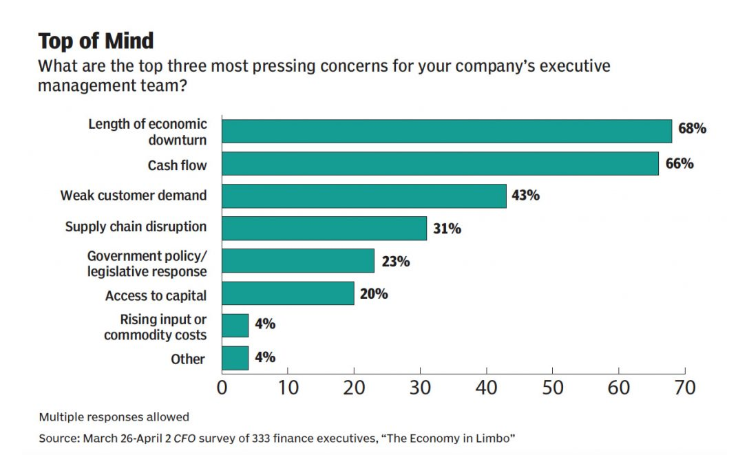
CFOs are concerned with the potential length of this downturn.  CFO surveyed financial executives and found that they are taking immediate financial action to “survive revenue and profit impacts.” More than half of these executives are estimating a drop in sales between 1 – 20% in the first quarter of 2020. But on a positive note, 46% said they expected a “V-shaped recovery.”

The Office of Finance in the COVID-19 Economy

McKinsey & Company recently wrote about The CFO’s Role in Helping Companies Navigate the Coronavirus Crisis. In it, they state,

“The CFO can play a strong, central role, alongside executive peers, in stabilizing the business and positioning it to thrive when conditions improve … The CFO is the leader, after all, who most directly contributes to a company’s financial health and organizational resilience day to day.”

CFO reports their second concern was cash flow. This is critical, but not unmanageable. This is where the Office of Finance plays a central role in helping the organization survive. Your 2020 budget, plan, and forecast are all irrelevant now.  You need to adjust your forecast to give an accurate financial outlook to senior management and investors. Your forecast must reflect new operational metrics for changes in production facilities, staffing and purchasing. It is imperative to change your forecast to show long-term plans for banks and other lenders.

To do that you need to understand what your business model looks like now. Not what it did when you put together your original FY2020 forecast. But what it looks like today, with schools, malls and restaurants closed, production lines stopped or transformed into making PPE, shipments delayed, and vital parts of our supply chains overwhelmed.

Do you have an accurate understanding of your model? The time to act is now. The business environment is uncertain now, and it’s impossible to predict what the next few quarters will look like – regardless of your industry, size, or location.

Home » FP&A » Page 4

Filed Under: FP&A Done Right Tagged With: Analytics, coronavirus, COVID-19, FP&A, FP&A done right, Revelwood

FP&A Done Right: Spreadsheets are Outdated

April 17, 2020 by Revelwood Leave a Comment

FP&A Done Right

This is a guest blog post from our partner Workday Adaptive Planning, written by Adaptive Insights’ Founder Rob Hull. It was originally published on FEI Daily.

The global marketplace is moving faster, requiring companies to be more agile than ever in this age of urgency. Yet businesses—and specifically finance teams—still rely on tools that sustained them decades ago. Those tools were designed for an age when planning was an annual, top-down and linear process, but today we no longer have the luxury of devoting an average of 77 days to develop an annual plan. Change is continuous, so planning must be too.  And it must also be more collaborative.

The rapid change in our technological ecosystem is causing a growing number of finance chiefs to tell their staff to find tools better suited to modern business planning and analysis than spreadsheets — for decades the default planning application for virtually every business. The inconveniences of spreadsheets for planning and analysis, such as version control errors stemming from manual data entry, clumsy email collaboration, and the challenges of creating a single source of truth from disparate data sources can now be a distant memory thanks to modern planning tools. As Bernard Marr observed in Forbes, spreadsheets may still be a great choice for some tasks, but not for the kind of agile planning and analytics required in today’s fast paced business environment.

From the cloud, a different way to plan

These and other observers have pointed to the rise of cloud-based planning software that has taken the fundamental capabilities of the noble spreadsheet and turned them into something that spreadsheets never quite managed to be – automated, intuitive, collaborative, integrated, multi-dimensional, and always up to date. Just as cloud-based CRM applications like Salesforce.com replaced legacy applications like Siebel, so too are cloud planning solutions replacing spreadsheets and legacy applications to provide much needed agility in today’s era of urgency.

Spreadsheets are a wonderful personal productivity tool, and as such will continue to have a place among business applications. But for company-wide finance, sales, and workforce planning, reporting and analysis, the future will look different than the past.

The future of planning is unfolding

With the advancement in technology, we’re starting to see menial tasks accomplished through automation, making time for teams to spend on high value tasks. Finance execs report that, on average, 83 percent of their staff’s time is spent on manual, menial tasks like data input and consolidation. That’s lost time that could be converted to more valuable and strategic tasks with better tools for planning, reporting and analysis.

Pinsent Masons LLP, a UK-based law firm with offices throughout Europe, the Middle East, Africa, Asia, and Australia, found that swapping out spreadsheets for cloud-based planning, reporting and analysis helped automate previously manual tasks, freeing finance staff to be more strategic. “We spent 70 percent of our time entering and verifying data, and 30 percent viewing and interpreting it,” notes Andrew Brett, who heads financial reporting at Pinsent Masons. “We now can spend seven out of every 10 hours gleaning insight from our data.”

Meanwhile, anytime, anywhere access and intuitive application design make planning far more collaborative. Spreadsheets are great for individual users, but in small groups, they’re less great and in large groups, they’re abysmal. On the other hand, cloud solutions were built for collaboration. They allow any authorized participant to work on a plan, from anywhere, at any time. Better still, you’ll always know who made changes and when. Leading cloud vendors have introduced intuitive planning interfaces that make it easy for non-finance personnel to collaborate, enter data, create reports, and run what-if scenarios because they recognize that in business, everybody plans.

Organizations that make the digital transformation leap for planning will see gains in scale and speed. The spreadsheet wasn’t built for enterprise scale, but the cloud was – modern cloud-based planning solutions can support thousands of concurrent users and highly complex multi-dimensional models. Modern solutions are also built to address the performance demands of enterprises. The most advanced cloud planning software solutions use powerful modeling engines that add memory and compute resources when needed and remove the data limits finance pros have come to despise.

Teams can also access data from every corner of the business. Manually importing enterprise data into spreadsheets can be complicated and troublesome — and that’s being polite. In contrast, the best cloud platforms automatically integrate data from your ERP, HCM, CRM and other transactional data sources so that you can refresh data with a single click and know you are working with the latest information.

Mind the gap

There’s a dangerous gap that can emerge when companies rely on outdated processes while their competitors embrace new, more agile ways of working. Agile teams produce market-leading results. The gap yawns even wider for companies still relying on tools developed for the way businesses operated before the internet changed…well, everything.

Holistic company-wide planning isn’t the pipe dream it once was – it’s now a business imperative and it’s the key to unlocking the kind of agility that turns planning into a competitive advantage. Realizing this, more and more execs are coming to the same conclusion: On the journey to the future, spreadsheets for business planning have become as archaic as the Rolodex.

Rob Hull is the founder of Adaptive Insights, a Workday company. Rob had a vision to provide modern finance leaders with an easy-to-use SaaS-based solution to manage business performance. Today that vision is a reality for thousands of businesses around the world.

This post also appeared on the Workday Adaptive Planning blog.

Read additional FP&A Done Right blog posts from our partner Adaptive Insights:

FP&A Done Right: Can you Recover from Static Planning?

FP&A Done Right: How to Improve your Financial Reporting Process

FP&A Done Right: 3 Barriers to Business Agility

Home » FP&A » Page 4

Filed Under: FP&A Done Right Tagged With: Adaptive Insights, Analytics, Budgeting, Budgeting Planning & Forecasting, Financial Performance Management, FP&A, FP&A done right, Planning & Forecasting, Planning & Reporting, Revelwood, Rob Hull, spreadsheets

IBM Planning Analytics Tips & Tricks: Excel’s IFS Function

January 21, 2020 by Revelwood Leave a Comment

Tips & Tricks

While the IF function has been around for a while now, IFS is new to Excel. This function checks whether one or more conditions are met and then returns the value associated with the first TRUE condition. The main objective of IFS is to simplify an expression that would have previously required multiple nested IF functions.

The general format of the IFS function is

=IFS(Condition 1, Value if Condition 1 = TRUE, Condition 2, Value if Condition 2 = TRUE, Condition 3, Value if Condition 3 = TRUE)

The function can handle up to 127 different conditions, and only the first two parameters are required.

Here is an example using a sample Excel grid:

IBM Planning Analytics Tips & Tricks: Excel's IFS function
=IFS(A1>250,A2,B1>250,B2,C1>250,C2,D1>250,D2)

will return “Green” (the value of cell C2).

In older versions of Excel, this would be written as

=IF(A1>250,A2,IF(B1>250,B2,IF(C1>250,C2,IF(D1>250,D2))))

Multiple nested IF functions would previously be used to accomplish the same result.

IBM Planning Analytics, which TM1 is the engine for, is full of new features and functionality. Not sure where to start? Our team here at Revelwood can help. Contact us for more information at info@revelwood.com. And stay tuned for more Planning Analytics Tips & Tricks weekly in our Knowledge Center and in upcoming newsletters!

Want to get our Planning Analytics Tips & Tricks delivered to your inbox every Tuesday? Sign up to get our weekly email of just the week’s tip!

Read related posts with Excel Tips & Tricks and using Excel with Planning Analytics:

IBM Planning Analytics Tips & Tricks: New Excel Feature – XLOOKUP

IBM Planning Analytics Tips & Tricks: Learn the Excel CELL Formula

IBM Planning Analytics Tips & Tricks: Recalculating Excel Worksheets

Home » FP&A » Page 4

Filed Under: IBM Planning Analytics Tips & Tricks Tagged With: Analytics, Excel tips & tricks, Financial Performance Management, FP&A, IBM Cognos TM1, IBM Planning Analytics, Nina Gordy, Revelwood, TM1

FP&A Done Right: The Victors of the Decade Combine Agility and Resilience

December 20, 2019 by Ken Wolf Leave a Comment

FP&A Done Right

As we near the end of the decade, it’s a good time to think back about what businesses have learned from an FP&A perspective, and how they can fortify and position themselves for the next decade and for future decades.

The beginning of this decade saw the evolution of online analytical processing (OLAP) systems, such as our beloved TM1, grow into comprehensive and sophisticated platforms for holistic financial and operational performance management. In theory we had the tools to empower Finance to reveal the secrets of business success locked in our systems and in our data.

The last few years of the decade have seen our imaginations captured by the disruptors, the unicorns and those who have seemingly mastered the elusive “digital transformation.” But as we’ve learned over the last quarter, some of those “darlings” of the business world may not be the successes they first appeared to be. Take WeWork for example: the company has not managed growth effectively. They are at a point (or possibly past it) where Finance could step in, do some serious analysis and revisit the company’s business model. Other headline catching companies are growing exponentially, but struggle with delivering profits. This too, points to where Finance can be playing a larger role.

Business Resilience? Or Agility?

These musings were prompted by a recent article by McKinsey on business resilience. When we think about disruptors and unicorns, we might associate them more with the popular FP&A theme of business agility. One of our business partners, Adaptive Insights, frequently talks about business agility in the context of needing to make faster and more informed decisions. The backbone of this is continuous planning, which is spearheaded by the Office of Finance.

In one sense, perhaps, business agility is the young business, the quick, rookie running back on the football field – dodging and weaving and making stellar plays, with end zone celebrations when the offense is in control of the game.

But where does resiliency come in? To me, the resilient business is the more established, mature defensive linebacker, whose job is to thwart the competition, and who is less likely to be celebrating in the end zone, but just as important to winning the game.

The question for all of us, on the precipice of a new decade is, “Will we be playing a mostly offensive game in the next few years, or a mostly defensive game? Perhaps both.” And furthermore, how do we, the CFOs and the leaders in the Office of Finance, best prepare, plan and enable our organizations for what’s to come?

Facing the Future

McKinsey mentions that while we are still in “the largest global economic expansion in history, the outlook is uncertain.” Isn’t it always? The article states that in the company’s latest survey on economic conditions, “executives’ views on the current global economy and expectations of future global growth are less favorable than they have been in years.” I’d posit a good executive is outwardly optimistic and inwardly financially, cautiously pessimistic.

It is in this context that McKinsey examines what makes a company resilient. The article defines resilient organizations as those that exhibit a “willingness to take decisive action to strengthen their balance sheets and improve cash flow before the [previous] downturn hit, often by divesting non-core assets, reducing debt, and improving the efficiency of working capital.” To become a resilient business, McKinsey recommends the following three steps:

  1. Enhance the role of the finance team. They recommend doing this in strategic planning, business analytics and decision-making at all levels of the organization. As the article states, “The best way to do this is to embed finance managers alongside business unit leaders and empower them to be partners in running the business.” Think about that for a moment – take the traditional “bean counter” out of Finance and put her or him with the business unit leader. Imagine the possibilities: the finance professional knows where the data is, how to get answers from that data, and how to slice and dice that data in different ways. The business leader knows what questions to ask – questions urgent for today’s business challenges and vital for tomorrow’s business opportunities and threats.
  2. Pressure test capital structure and scenario plan. McKinsey recommends doing this with both capital structure and cash flow, and using a range of scenarios, “from an economic crisis to other disruptive events.” You might feel somewhat certain your industry will not have a massive disruption like that of Uber on the taxi industry. But what if you are a sports arena? How much overall revenue could, for example, MetLife Stadium lose should there be an NFL strike? Over how many games? While that is not a global crisis, it is an economic crisis with impact far beyond ticket sales. On a global level, are companies pressure testing and scenario planning for the potential impact of Brexit, of various international tariffs and trade disputes that, significantly increase the price of French cheeses and wines served at the high-end luxury suites at a stadium?
  3. Take immediate action to harvest hidden value from their balance sheet. McKinsey research shows “that working capital management is surprisingly variable, even among companies in the same industry.” The organization has found that “large companies that make a focused effort can typically free up more than $100 million from working capital and redeploy it to priority projects.” This argues for going beyond traditional budgeting and embracing more flexible planning methodologies, such as rolling forecasting or active planning. For example, McKinsey revealed that they saw “upside realized by companies that consistently track cash returns on an asset level and that make an ongoing effort to reevaluate and mitigate their liabilities.” With traditional budgeting and planning, you are assessing your balancing sheet in the past. By adopting rolling forecasting or active planning – where you have the tools and skill sets to assess and adjust your balance sheet proactively – you have the power to gain this upside.

As McKinsey states, “While most CFOs have a role in setting company strategy, the rest of the finance organization are sometimes viewed as passive scorekeepers. Best-in-class organizations, in contrast, expect their finance professionals to play a substantial role with business-unit leaders to set strategic priorities.”

Your Game Plan: Find Your Enabling Technology

So, what’s your best game plan for the coming years? McKinsey specifically mentions these best-in-class organizations have finance teams that “utilize innovative performance management tools to help determine how the business is actually performing and suggest steps to optimize results.” At Revelwood we’ve been consulting on and delivering solutions for financial and operational performance management for 25 years. One would think most mid-sized businesses have moved off of spreadsheets for their budgeting, planning and reporting activities. But, day-after-day, our team here speaks with not just new upstarts, but established, even large, publicly traded companies that rely on spreadsheets as the backbone of their core activities in the Office of Finance. Spreadsheets have a role in the Office of Finance and always will. But any organization that uses only spreadsheets simply can’t achieve true resiliency. And they can’t embrace agility.

Your Game Plan: Think Differently About the Office of Finance

How can you unlock the potential hidden within your finance team to add true value to the business? Think differently about how to enhance your team members’ roles. Maybe it’s even a matter of breaking up some aspects of the physical office and having finance team members sit among their associated business units. Separate their function from their strategic role. Be agile about how you think about your people and what they can do for the business.

The End Game: Resilience and Agility

As I mentioned, we think the victors of the next decade will strike a good balance between resilience and agility. Or, offense and defense. Invest in the right enabling technology, rethink the role of the Finance team, and build the skillsets and mindsets for both. That’s your best game plan.

Home » FP&A » Page 4

Filed Under: FP&A Done Right Tagged With: Adaptive Insights, agile planning, Analytics, business agility, business resilience, continuous planning, Financial Performance Management, FP&A, FP&A done right, IBM Planning Analytics, ken wolf, Rolling Forecasts, TM1

FP&A Done Right: What Prevents Business Agility

December 6, 2019 by Revelwood Leave a Comment

FP&A Done Right

This is a guest blog post from our partner Workday Adaptive Planning, written by Gary Cokins. Cokins examines what business agility really means for the Office of Finance.  

There’s a lot of talk these days about business agility. Yet it’s much more than just a trendy new business term to throw around at a networking lunch. Ask any C-suite executive if their organization could be more agile, and they will likely answer yes. But what does agility mean, and why does it matter?

An agile company can respond quickly to change as it happens, opening the door to new opportunities and minimizing the risks of threats and challenges from competitors, changing market conditions, digital technology disruptions, etc. If your company can think fast, be nimble, and move first, it’s positioned to gain a significant competitive advantage in today’s data-driven, fast-paced world.

A problem is many companies over-plan and under-execute. To be competitive today, companies must embrace a “speed to results” culture. This does not mean a “ready-fire-aim” approach to decision-making and actions. But they must move fast with a constant sense of urgency.

“Any company designed for the 20th century is doomed to failure in the 21st,” says David Rose, CEO of Gust. In other words, agility is no longer a nice-to-have. It’s the cornerstone of modern business success. But achieving a responsive, dynamic organization is easier said than done.

Barriers to agility are often so entrenched that overcoming them can seem incredibly challenging, especially when compounded by static, manual planning. Relying on racked-and-stacked table reports is insufficient. Robust modeling software, enhanced with visualization features, is needed.

Ultimately, business agility is about having the right tools to efficiently manage and measure change quickly, accurately, and comprehensively. And most of that comes down to how you plan. What is needed can be referred to as “active planning.”

Here are the three primary barriers to business agility:

Barrier #1: Manual processes and ad hoc reporting

Most finance teams use Excel to create reports, track financial projections and budgets, and synthesize numbers across departments. And it’s no wonder. Excel is an effective tool for building custom formulas, scenarios, and look-ups. As a stand-alone budget and reporting tool, however, it has some significant drawbacks, including the slow, cumbersome processes Excel perpetuates. Using Excel’s columns-to-rows math is restrictive. Greater flexibility is needed with modeling software.

Relying on Excel to reconcile budget numbers and bring business unit projections into alignment with corporate forecasts is a herculean task—rife with errors, broken formulas, and missed deadlines. By the time finance gets the numbers to match, they’re usually out-of-date.

Then there are time-consuming ad hoc requests. Who hasn’t had a CFO request detailed reports about revenue fluctuations or variances of planned-to-actuals by region, or expense increases due to higher healthcare premiums? In fact, 60% of CFOs say ad hoc analysis can take up to five days. Ultimately, ad hoc reporting is used to fill a gap in a company’s reporting process—a gap that can be filled with automated planning and reporting.

Excel doesn’t need to be replaced, however. Excel can augment automated planning. Used in conjunction with a cloud planning solution, it becomes one piece of a continuous, comprehensive, and collaborative planning process.

Barrier #2: Lack of alignment and collaboration

World-class companies know that organizational alignment on KPIs is a predictor of business success. Tracking performance against goals, ideally with targets set for the KPIs, and then flagging under- or over-performing business units monopolizes finance team resources. Finance is so busy with low-value but time-consuming tasks like balancing spreadsheets, fixing broken formulas, and nudging managers to submit budget requests, that they’re usually too swamped to steer overall financial strategy, let alone help facilitate and build collaboration.

Manual tasks hold finance hostage to mundane (albeit critical) processes, keeping data siloed and business decision-makers in the dark. Lining up behind KPIs is extremely difficult under these circumstances. These pockets of disconnected information keep decision-makers from effectively planning for what’s next.

And alignment around KPIs or collaboration under these circumstances? Not likely.

It’s not surprising that a majority of CFOs report lack of time as the biggest barrier to collaboration. Continuous firefighting and pursuing short-term priorities get in the way. When business processes become more efficient, however, collaboration is achievable. Productivity increases. Without alignment with KPIs, the disconnects between sales and operations, or production and management, or marketing and sales, make true agility impossible.

Barrier #3: Disjointed planning

By their very nature, resource allocation decisions need to reflect current circumstances—not the supply and demand challenges from last year and not financial reports that are three months old. Whether or not to hire more people, alter supplier relationships, invest in skills training, or accelerate capital investment plans largely depend on whether an organization plans effectively and agilely. And to plan effectively requires far more than a series of budget meetings and annual reports. It gets worse when different departments have their own set of numbers, revealing the need for a single version of the truth.

Disjointed and static planning flows from ad hoc information, missing data, and siloed decision-making. Active planning, on the other hand, helps organizations predict and respond quickly to potential gaps in performance and course-correct swiftly and agilely to changing market conditions.

But to do that requires a comprehensive and collaborative approach to planning that incorporates the latest information in near real time. In short, it requires active planning.

A way forward

The sought-after capabilities of agility—to see change coming, rapidly adapt to it, and turn uncertainty into business opportunities—can only be achieved by changing fundamental processes. Automating reporting so that it flows from multiple coordinated systems (ERP, CRM, HCM, etc.), generating reports in real time, and giving managers access to self-service reporting are all critical to an active planning process. Equally critical is to avoid digitally cementing existing processes that need to be redesigned.

While static planning produces monolithic plans that aren’t a true reflection of the business environment, active planning is different. It’s about listening to what your data is telling you about your goals, resources, suppliers, customers, competitors, and the wider market. Where static planning is top-down, siloed, slow, and limited, active planning is collaborative, continuous, and comprehensive. In other words, active planning allows you to plan and forecast at the speed of modern business.

By deploying a modern planning solution that enables active planning, your company can streamline FP&A processes, gain insights more quickly, and make better decisions faster. And be able to respond to change as it happens.

Don’t get stuck in the back office reconciling numbers and fixing broken links. Become a strategic partner by giving decision-makers access to the information they need with easy-to-use self-service reports, up-to-date data, and strategic insights.

Barriers to agility? With active planning, they’re easy to overcome.

Gary Cokins is an internationally recognized expert, speaker, and author in enterprise and corporate performance management (EPM/CPM) systems. He is the founder of Analytics-Based Performance Management LLC. Gary can be reached at gcokins@garycokins.com

This blog post was originally published on the Workday Adaptive Planning blog.

Sign up for our FP&A Done Right series

Get our FP&A Done Right series sent directly to your inbox. Sign up here. 

Home » FP&A » Page 4

Filed Under: FP&A Done Right Tagged With: Adaptive Insights, Analytics, Financial Performance Management, FP&A, FP&A done right

  • « Go to Previous Page
  • Page 1
  • Page 2
  • Page 3
  • Page 4
  • Page 5
  • Page 6
  • Page 7
  • Go to Next Page »

Footer

Revelwood Overview

Revelwood helps finance organizations close, consolidate, plan, monitor and analyze business performance. As experts in solutions for the Office of Finance, we partner with best-in-breed software companies by applying best practices guidance and our pre-configured applications to help businesses achieve their full potential.

EXPERTISE

  • Workday Adaptive Planning
  • IBM Planning Analytics
  • BlackLine

ABOUT

  • Who We Are
  • What We Do
  • How We Help
  • How We Think
  • Privacy

CONNECT

World Headquarters

Florham Park, NJ | 201 984 3030

European Headquarters

London & Edinburgh | +44 (0)131 240 3866

Email
info@revelwood.com

Copyright © 2026 · Revelwood Inc. All rights reserved. Revelwood® and the Revelwood logo are registered marks of Revelwood Inc.